Crop report for the period April 28 to May 4, 2026
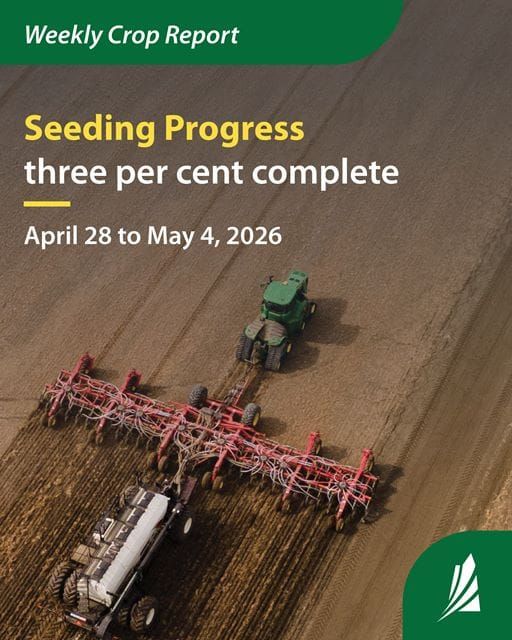
Spring seeding is underway in some areas of Saskatchewan while other areas are delayed due to flooding and runoff. Currently, three per cent of the 2026 crop has been planted, behind the five-year average of 12 per cent and the 10-year average of 13 per cent.
April 28, 2026
Media Release, Gov't SK
Key points from this story:
- Spring seeding is underway in Saskatchewan.
- Three per cent of crops planted.
- Southwest region is most advanced.
- Cold temperatures limit seeding progress.
- Pasture conditions reported as mixed.
- Farm Stress Line available for producers.
Spring seeding is underway in some areas of Saskatchewan while other areas are delayed due to flooding and runoff. Currently, three per cent of the 2026 crop has been planted, behind the five-year average of 12 per cent and the 10-year average of 13 per cent. Cold temperatures, frozen soils and washed-out roads are limiting seeding progress for many areas; this is expected to change in the coming weeks.
The southwest region is the furthest advanced with seven per cent seeded. The southeast region is also making progress with five per cent seeding complete. The west-central region is reporting only one per cent complete and the east-central, northeast and northwest regions are all reporting that seeding is delayed.
Cereal crops such as triticale and durum are leading the seeding progress while pulse and oilseed crops are just getting underway. Seeding progress is as follows:
Cereal crops:
- 16 per cent for triticale;
- 10 per cent for durum;
- Four per cent for barley;
- Two per cent for spring wheat and oats; and
- One per cent for canary seed.
Pulse crops:
- Six per cent for field peas;
- Four per cent for lentils; and
- Three per cent for chickpeas.
Oilseed crops:
- Three per cent for mustard and canola; and
- Two per cent for flax.
Perennial forages:
- One per cent.
Limited moisture throughout much of the province over the past week will allow saturated fields to begin to dry up and seeding operations to get underway. The highest reported rainfall was in the Rockglen area at eight millimetres (mm) followed by the Carnduff area at three mm.
Although provincial topsoil moisture conditions are mainly at adequate levels, there are some areas in the province experiencing drier or surplus conditions.
Cropland topsoil moisture is:
- 24 per cent surplus;
- 69 per cent adequate;
- Seven per cent short.
Hayland topsoil moisture is:
- 14 per cent surplus;
- 71 per cent adequate;
- 14 per cent short;
- One per cent very short.
Pasture topsoil moisture is:
- 10 per cent surplus;
- 71 per cent adequate;
- 18 per cent short;
- One per cent very short.
Livestock producers in the west-central and southwest regions are hopeful for moisture in the coming weeks to support water supplies and pasture conditions throughout the season. Spring runoff was reported in late April, with provincial data indicating 32 per cent below normal, 32 per cent normal and 36 per cent above normal. 81 per cent of crop reporters indicated that the amount of runoff received would be sufficient to replenish dugouts and other water bodies within their area. Notably within the west-central and southwest regions, 61 per cent and 45 per cent of respondents respectively indicated that the amount of runoff would not be sufficient to replenish dugouts within their area.
Additionally, pasture conditions were also reported in late April, with provincial data indicating six per cent of pastures to be in excellent condition, 42 per cent reported to be in good condition, 24 per cent reported as in fair condition, 20 per cent reported as poor and eight per cent very poor.
With the drier weather this week, some producers are busy in their fields with seeding, pre-seed spraying for weed control, harrowing and rock picking while others are waiting for the water to recede and the land to dry up. Livestock producers are busy calving with some producers finishing up for the season. As cattle are being moved out to pasture, producers are also busy checking and fixing fences.
As spring progresses, producers are reminded to be safe during their field activities and watch for overhead powerlines while moving equipment in fields and farmyards this spring.
A reminder that the Ministry of Agriculture is partnering with Sask Ag Matters to offer the Farm Stress Line. Producers, their families and farm employees can call the toll-free number, 1-800-667-4442, at any time for confidential, free services from mental health professionals trained in issues facing producers.
A complete, printable version of the Crop Report is available online.
Follow the 2026 Crop Report on X at @SKAgriculture.
Last Mountain Times Newsletter
Join the newsletter to receive the latest updates in your inbox.