
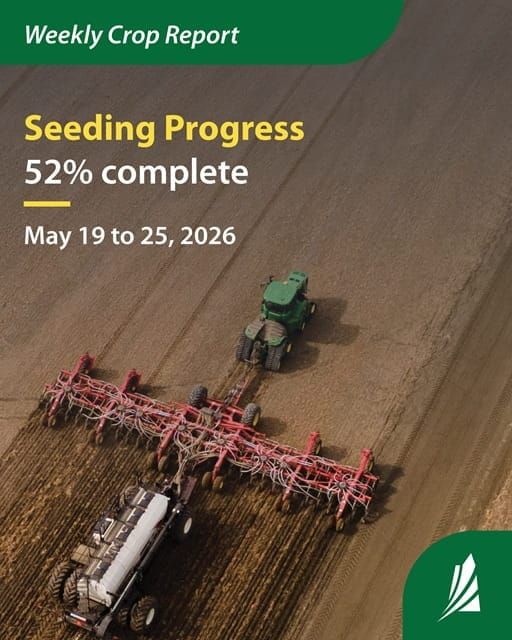
Crop report for the period may 19 to 25, 2026
Producers made significant seeding progress this week, thanks to favourable weather conditions in most of the province. Seeding progress reached 52 per cent, which continues to be behind both the five-year average of 74 per cent and the 10-year average of 77 per cent.
May 19, 2026
Media Release, Gov't SK
Key points from this story:
- 52 per cent seeding progress this week
- Southwest region leads at 74 per cent
- Pulse crops most advanced in seeding
- Topsoil moisture levels stable overall
- Minor crop damage reported across province
- Farm Stress Line available for producers
Producers made significant seeding progress this week, thanks to favourable weather conditions in most of the province. Seeding progress reached 52 per cent, which continues to be behind both the five-year average of 74 per cent and the 10-year average of 77 per cent. Regionally, the southwest continues to lead seeding progress at 74 per cent complete due to early field access and generally drier conditions. The west-central region is close behind at 69 per cent. Progress in the southeast region reached 61 per cent, and the northwest region reached 55 per cent, with producers continuing to make gains as field conditions improve. The east-central region is 26 per cent seeded, and the northeast region is just behind at 25 per cent complete. While these regions experienced comparatively slower progress due to less favourable field conditions, seeding activity continues to advance as opportunities allow. Pulse crops, including lentils and field peas, remain the most advanced in seeding progress, while cereals and oilseed crops continue to expand steadily, contributing to a consistent increase in overall seeded acreage.
Cereal crops 74 per cent for durum; 52 per cent for spring wheat; 50 per cent for barley; 45 per cent for triticale; 36 per cent for canary seed; and 26 per cent for oats. Pulse crops 77 per cent for field peas; 76 per cent for lentils; and 55 per cent for chickpeas. Oilseed crops 56 per cent for mustard; 38 per cent for canola; and 34 per cent for flax. Perennial forages 23 per cent. Rainfall varied across the province this past week, with the highest amount reported in the Martin area at 60 millimetres (mm). The Craik area received 59 mm, the Fertile Belt area received 45 mm, while the Stanley and Abernethy areas received 40 mm, respectively. Overall, topsoil moisture levels remained relatively stable, despite some areas receiving precipitation alongside high temperatures and windy conditions. Cropland topsoil moisture is 19 per cent surplus; 70 per cent adequate; and 11 per cent short. Hayland topsoil moisture is 14 per cent surplus; 70 per cent adequate; and 16 per cent short. Pasture topsoil moisture is Nine per cent surplus; 68 per cent adequate; 20 per cent short; and Three per cent very short.
Crop development varies due to localized weather, leading to differences in temperature and moisture. Currently, fall cereals are at 58 per cent of normal development, with one per cent ahead and 41 per cent behind in development. Spring cereals are 37 per cent normal, 63 per cent behind. Pulse crops are 45 per cent normal and 55 per cent behind. Oilseeds are at 27 per cent of their normal stage of development and 73 per cent behind. Perennial forage is 50 per cent at normal development, with two per cent ahead and 48 per cent behind. Annual forage is at 39 per cent normal development, with two per cent ahead and 59 per cent behind.
Crop development remains generally behind across all categories, with minimal acres ahead of normal. Oilseeds and spring-seeded crops are showing the greatest delays, while fall cereals and perennial forage are closer to expected stages. Crop damage across the province was generally minor. Some producers reported localized damage caused by flooding, wind, frost and gophers. In addition, dry conditions and periods of heat contributed to minor crop stress in certain areas. Insect activity was observed, with some producers implementing control measures where populations warranted intervention. If weather conditions remain favourable, most producers anticipate that seeding will progress rapidly next week. In addition to seeding, producers are busy moving cattle to pasture, applying herbicides and land-rolling. As producers continue with seeding and field operations, they are encouraged to prioritize safety in all activities. The Farm Stress Line is available to provide confidential support for producers toll-free at 1-800-667-4442. A complete, printable version of the Crop Report is available online.
Last Mountain Times Newsletter
Join the newsletter to receive the latest updates in your inbox.