
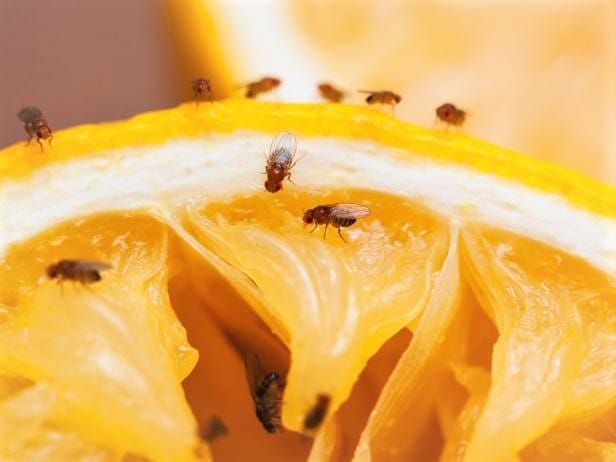
Fruit flies
It is the time of year where we have a number of unwanted guests around the house. There is a host of tiny little fruit flies happily flitting about the fruit bowl. Fruit flies are evident in the home at any time of year, but they are most commonly encountered a bit later in the growing season.
September 17, 2026
Patricia Hanbidge, Lead Horticulturist, Orchid Horticulture
Key points from this story:
- Fruit flies are common in late summer
- Each female lays up to 500 eggs
- Infestations often start with infested fruit
- Locate breeding sites to eradicate flies
- A simple trap can be made with yogurt container
- Adults disappear once breeding site is gone
It is the time of year where we have a number of unwanted guests around the house. There is a host of tiny little fruit flies happily flitting about the fruit bowl. Fruit flies are evident in the home at any time of year, but they are most commonly encountered a bit later in the growing season. Although they are mostly annoying they are responsible for causing a high percentage of insect contamination of fruit and fruit products by depositing bacteria and other disease causing organisms. Fruit flies feed in the same fashion as house flies so their sponging mouthparts work by depositing saliva onto the food and then sucking up the solution.
The adults are easy to spot being a hefty 2.5 mm (1/8 in.) long with large red eyes and a tan to black body. Fruit flies lay eggs on fermenting fruits and vegetables and any other accommodating moist organic surface as long as there is some fermentation of some kind of organic material in process. The eggs will hatch within days and larvae will become breeding adults within a week. This is significant as each female may lay as many as 500 eggs in her short lifetime. This leads to a population explosion if all factors are favourable.
I have fond (or not so fond) memories of genetics labs that favour the study of fruit flies - specifically due to their prolific regeneration! However, for homeowners, this enormous breeding potential simply means that a little bit of fruit rot can quickly generate a house full of flies.
The infestations will generally originate when infested fruits or vegetables are brought into the home and left at room temperature, but adult flies may also gain entry through poorly screened doors and windows. At this time of year, we have such abundance of produce that many sites in the home are attractive to these little critters. Fruit flies will also breed in drains, recycle bins, garbage containers or even dirty mops or other cleaning apparatus that remain moist for a period of time.
The most important step in eradicating fruit flies is to locate where they are breeding. Any fruit or vegetables that are ripe should be refrigerated, eaten or discarded. If you suspect that a drain is the prime breeding site, then tape a plastic bag over the drain for a night and look in the morning for adult fruit flies. If you find some then simply flush the drain with hot water to help keep it as clean as possible. It is also a good idea to use a fine mesh screen to prevent them from getting in and out of the drain area.
A simple trap can be set up on your kitchen counter by using a used (and washed) yogurt container covered with saran wrap. Simply place a banana peel in the container (or other fruit part), cover with saran wrap secured with an elastic band. Poke a number of small holes in the saran wrap big enough to accommodate the passage of a fruit fly. If you have a fruit fly problem, within a short period of time you fill find the container will be filled with flies able to enter but unable to find their way out. To take care of the captive flies, simply place the container in the freezer for a short period of time.
The lifespan of a fruit fly is relatively short, so once the breeding site is eliminated, adults soon disappear....and once the winter arrives, there is less chance of a repeat infestation.
Remember that as we get closer to Thanksgiving Day, I invite you to share an image or a few words on what you are thankful for in your life. Let's keep it related to the garden, but your perspective of the sky, or the earth in your garden count as being worthy of a snapshot or a comment. I am already hearing from some of you and as we get closer to Thanksgiving, I will share with you some of what has been shared with me.
Last Mountain Times Newsletter
Join the newsletter to receive the latest updates in your inbox.