
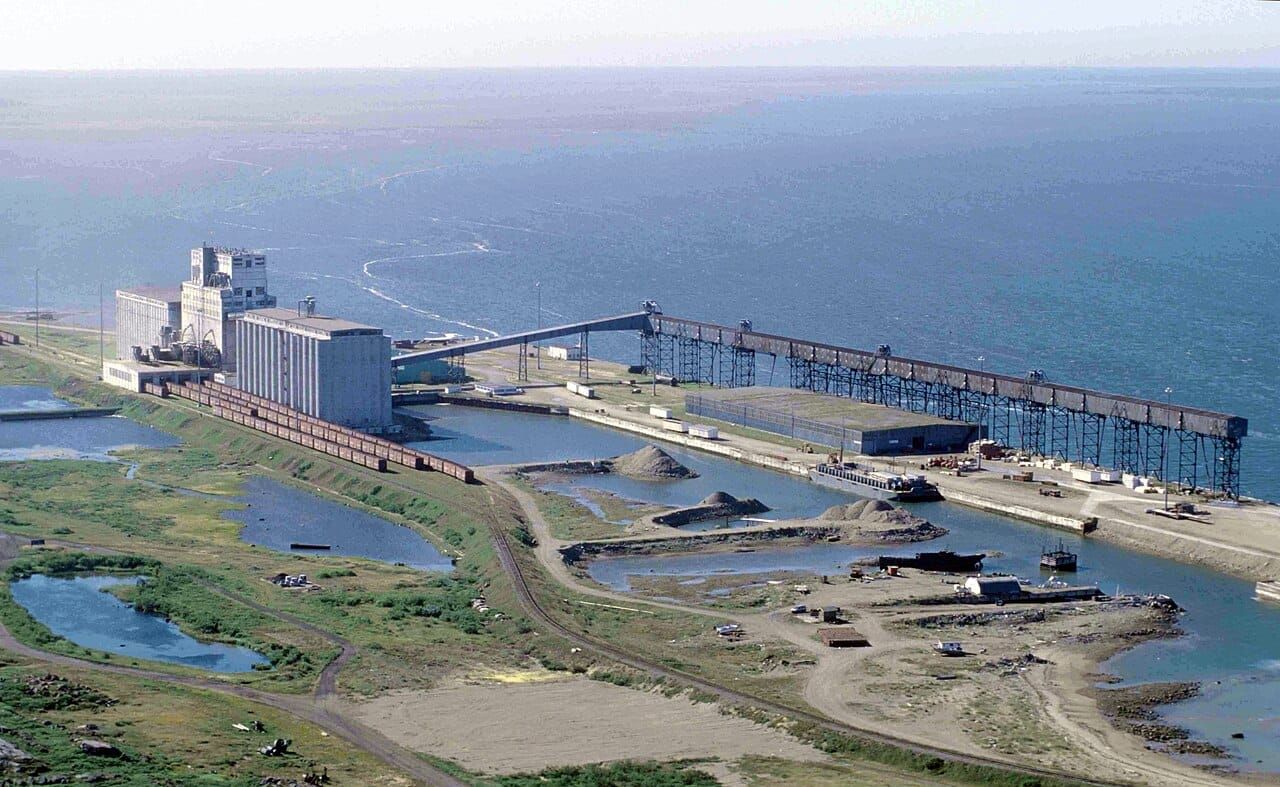
Port of Churchill revival
The Port of Churchill has long been seen by at least some as a vastly under-utilized Canadian asset in terms of export trade.
September 21, 2026
Key points from this story:
- First grain ship left Churchill since 2020
- 30,000 tonnes Saskatchewan durum wheat
- Arctic Gateway Group owns the port
- New partnership with AGT Foods
- Research finds year-round shipping feasible
- EU association talks could boost exports
The Port of Churchill, Canada's only deep-water Arctic seaport connected to a railway, and for producers in Saskatchewan and Manitoba - both agricultural crops and minerals like potash - it is the shortest rail haul to open water.
For years, the Hudson Bay Route Association (HBRA) lobbied for broader use of the port, with Willis Richford of Norquay, Sask. a vocal champion of that effort.
For decades, Richford and the HBRA lobbied governments and the agricultural sector to utilize and upgrade the Port of Churchill. But for more than half a decade, the port sat basically unused.
The facility, now under the Indigenous-led ownership of the Arctic Gateway Group – an Indigenous and community-owned Manitoba company that owns and operates the Port of Churchill – has become a focal point for massive expansion proposals, including a multi-billion-dollar provincial push to develop an Arctic trade corridor for critical minerals and clean energy.
Recently, the first grain ship to leave Churchill since 2020 loaded up in August.
The ship was bound for Europe, with 30,000 tonnes of Saskatchewan durum wheat. It's part of a new multi-year partnership between port owners Arctic Gateway Group and Saskatchewan's AGT Foods. Two additional grain vessels are expected at Churchill this season.
That shipment bound for Europe has taken on far greater significance in recent days as Canada looks to find trade partners it can trust in the wake of American President Donald Trump's heavy-handed bullying in trying to force Canada into a new deal to replace the recently ended Canada-United States-Mexico Agreement. Trump's tantrum-like response has been a wave of relationship-killing tariffs.
But, the U.S. is not the only country Canada can trade with. Last week, European Commission President Ursula von der Leyen opened the door for Canada to become an 'associate member' of the European Union. von der Leyen spoke of stronger co-operation between Europe and Canada in Strasbourg, France.
In her state of the union address, she said the two must re-imagine their partnership, and move beyond just a free-trade agreement. What such an arrangement could mean is far from clear at this point, with the 'devil being in the details, ' as they say.
However, the EU is a huge market and increased trade through any new association would be a huge step in offsetting the uncertainty of the Trump-effect.
That brings us back to the Port of Churchill as a very viable option to load ships bound for that expanded market - something that the thought of would have made Richford smile.
As it turns out the governments of Canada and Manitoba alongside the Arctic Gateway Group are talking new research confirming the feasibility of year-round shipping from the Port of Churchill using existing ice-class vessels, while changing sea-ice conditions are expected to make marine access increasingly favourable over the coming decades, Premier Wab Kinew and federal Northern and Arctic Affairs Minister Rebecca Chartrand, minister responsible for the Canadian Northern Economic Development Agency, announced recently in a release.
Ice freezing over the bay has long been a major barrier to shipping reducing it to a few weeks each summer.
"These studies are clear: year-round shipping out of the Port of Churchill is achievable today," said Kinew in the release. "This breakthrough means we can stop asking if year-round shipping from Churchill is possible and start building the infrastructure and attracting the investment we need to get it done. Now is the time for industry, investors and governments in Canada and around the world to invest in Churchill so we can build new trading partnerships that are fair and mutually beneficial, while we decrease our reliance on the United States."
With eyes now on the EU as a trade partner of increased importance the efforts to build on the Port of Churchill as a year round facility seems to dovetail nicely with an expanded trade future less reliant on a US with a belligerent leader who seems to hold little respect for that country's trade partners.
Last Mountain Times Newsletter
Join the newsletter to receive the latest updates in your inbox.