
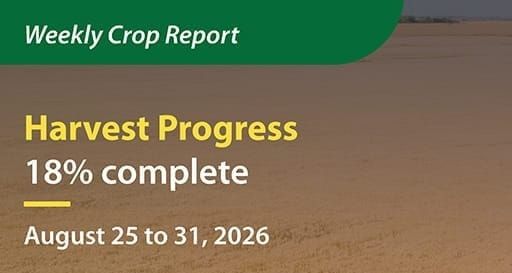
Crop report for the period August 25 to August 31, 2026
Last week began with predominantly dry conditions across much of Saskatchewan, allowing producers to make harvest progress. Harvest is now 18 per cent complete in Saskatchewan, up seven per cent from the previous week, although still significantly below the five-year average of 39 per cent.
September 03, 2026
Media Release, Gov't SK
Key points from this story:
- 18% harvest complete in Saskatchewan
- Significant rainfall improved topsoil moisture
- Winter wheat 74% and fall rye 88% harvested
- Lentils estimated at 1361 pounds per acre
- Crop damage mainly from wind and rain
- Farm Stress Line available for producers
Last week began with predominantly dry conditions across much of Saskatchewan, allowing producers to make harvest progress. Many regions received rainfall and localized hail later in the week and field activities continued where conditions permitted. Harvest is now 18 per cent complete in Saskatchewan, up seven per cent from the previous week. Progress remains significantly below the 5-year average of 39 per cent and the 10-year average of 34 per cent. Producers remain optimistic that favourable weather conditions will support further harvest progress.
Significant precipitation was reported in many areas later in the week. The Prairie Rose area recorded the highest rainfall at 136 millimetres (mm), followed by the Fertile Belt area at 125 mm. The Langenburg and Sasman areas also received 113 mm and 96 mm, respectively. The widespread precipitation significantly improved topsoil moisture conditions across much of Saskatchewan.
Cropland topsoil moisture is:
- 11 per cent surplus;
- 64 per cent adequate;
- 20 per cent short; and
- 5 per cent very short.
Hayland topsoil moisture is:
- 7 per cent surplus;
- 63 per cent adequate;
- 23 per cent short; and
- 7 per cent very short.
Pasture topsoil moisture is:
- 4 per cent surplus;
- 56 per cent adequate;
- 28 per cent short; and
- 12 per cent very short.
Harvest operations, primarily in winter cereals, pulses and other early-seeded crops, continued as weather conditions supported field activities.
Winter cereals harvested:
- Winter wheat: 74 per cent; and
- Fall rye: 88 per cent.
Oilseeds harvested:
- Mustard: 25 per cent;
- Flax: 1 per cent;
- Soybeans: 7 per cent; and
- Canola: 4 per cent.
Spring cereals harvested:
- Triticale: 68 per cent;
- Barley: 32 per cent;
- Durum: 20 per cent;
- Spring wheat: 6 per cent;
- Oats: 12 per cent; and
- Canary seed: 4 per cent.
Pulses harvested:
- Lentils: 73 per cent;
- Field peas: 66 per cent; and
- Chickpeas: 7 per cent.
The significant variation in growing conditions across Saskatchewan resulted in a wide range of yield estimates for all crops. Producers throughout the province continue to report considerable yield variability due to the dynamic nature of the growing season.
Current provincial average yield estimates are 52 bushels per acre for hard red spring wheat, 44 bushels per acre for durum, 94 bushels per acre for oats, 74 bushels per acre for barley, 41 bushels per acre for triticale, 38 bushels per acre for canola, 26 bushels per acre for flax and 39 bushels per acre for field peas. Lentil yields are currently estimated at 1361 pounds per acre, while mustard, canary seed and chickpea are 1129 pounds, 1266 pounds and 1501 pounds, respectively. In many parts of the province, weather conditions during the growing season had a significant impact on crop yields.
Crop damage over the past week was mainly due to wind and rain, which caused some localized flooding. Sclerotinia stem rot damage in canola was also reported, particularly in regions with high precipitation during the growing season.
Producers are actively working on combining, swathing and desiccating crops seeded later in the season. They are also busy baling and hauling straw, as well as transporting grain. Additionally, some producers have started making projections and plans for fall fieldwork to prepare the land for next season.
With harvest well underway, producers are reminded to follow safe operating practices and remain vigilant while working in the field. Having fire suppression resources readily available and taking precautions around power lines can help reduce risks during harvest. The public is encouraged to exercise caution and provide ample space when approaching or passing farm machinery on roads.
The Farm Stress Line is available to provide confidential support to producers, toll-free at 1-800-667-4442.
A complete, printable version of the Crop Report is available online.
Follow the 2026 Crop Report on X at @SKAgriculture.
Last Mountain Times Newsletter
Join the newsletter to receive the latest updates in your inbox.