
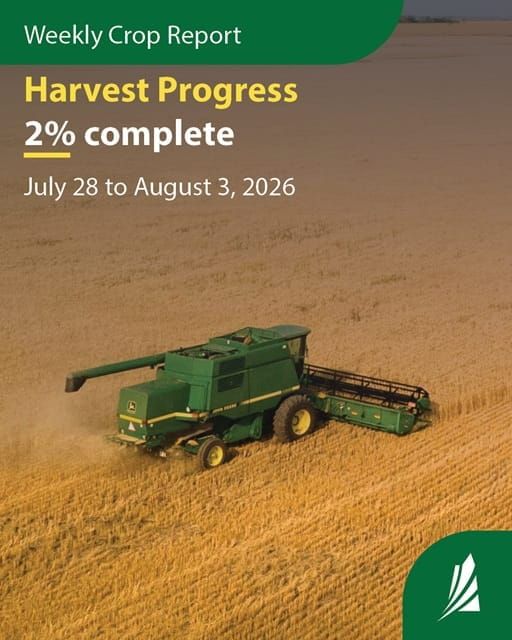
Crop report July 28 to August 3, 2026
Crops rapidly developed due to warm temperatures and dry conditions in many areas across the province this week. Early-seeded crops are nearing maturity in many areas, and rain likely would not benefit these crops.
Media Release, Gov't SK
Key points from this story:
- Crops rapidly developing due to heat
- Early harvest begins for some producers
- Topsoil moisture rated adequate in many areas
- Limited rainfall recorded across the province
- Farm traffic expected to increase during harvest
- Support available via Farm Stress Line
Crops rapidly developed due to warm temperatures and dry conditions in many areas across the province this week. Early-seeded crops are nearing maturity in many areas, and rain likely would not benefit these crops. However, producers in other areas are hoping for rain soon to help with grain fill in later-seeded crops.
While scattered showers brought limited moisture in some regions, most received no precipitation. The Milden area received the most rainfall with 31 millimetres (mm), followed by the Beaver River area with 28 mm and the Invermay area with 20 mm.
Despite the lack of rainfall, topsoil moisture is rated as adequate for over half of the province.
Cropland topsoil moisture is:
- 2 per cent surplus;
- 56 per cent adequate;
- 33 per cent short; and
- 9 per cent very short.
Hayland topsoil moisture is:
- 2 per cent surplus;
- 56 per cent adequate;
- 34 per cent short; and
- 8 per cent very short.
Pasture topsoil moisture is:
- 2 per cent surplus;
- 45 per cent adequate;
- 41 per cent short; and
- 12 per cent very short.
The hot and dry weather conditions have accelerated crop development, with most crops being rated as normal for this time of year.
- 4 per cent of fall cereals are reported as ahead, 86 per cent as normal and 10 per cent behind.
- 7 per cent of spring cereals are reported as ahead, 71 per cent as normal and 22 per cent behind.
- 6 per cent of oilseeds are reported as ahead, 65 per cent as normal and 29 per cent behind.
- 10 per cent of pulse crops are reported as ahead, 77 per cent as normal and 13 per cent behind.
- 2 per cent of perennial forages are reported as ahead, 83 per cent as normal and 15 per cent behind.
- 1 per cent of annual forages are reported as ahead, 78 per cent as normal and 21 per cent behind.
The dry conditions for much of the season in certain areas have led to some producers starting to harvest early-seeded crops and winter cereals. Provincially, harvest is two per cent complete with most of this progress occurring in the southwest.
Winter cereals harvested:
- Winter wheat: 7 per cent; and
- Fall rye: 21 per cent.
Spring cereals harvested:
- Triticale: 37 per cent;
- Barley: 1 per cent;
- Spring wheat: 1 per cent; and
- Oats: 2 per cent.
Many pastures are in good to fair condition, but a small portion is rated as in poor condition due to limited precipitation in certain areas. Currently, six per cent of pastures are in excellent condition, 53 per cent are good, 33 per cent are fair, seven per cent are poor, and one per cent is in very poor condition.
Crop damage was reported in areas experiencing hot temperatures paired with dry conditions, with some areas reporting minor to moderate damage. There were also reports of wind, grasshoppers and bertha armyworms causing minor crop damage in certain areas.
As producers prepare for and begin harvest, there will be increased farm equipment traffic on public roadways. Drivers are reminded to have extra patience and caution when encountering large equipment on the road. Additionally, farm equipment operating in dry fields can present a fire risk. Producers are encouraged to take precautions to mitigate fire risk and ensure harvest efforts are conducted safely.
For crop or livestock questions, producers are encouraged to call the Agriculture Knowledge Centre toll free at 1-866-457-2377.
This can be a stressful time of year for producers as weather conditions can be unpredictable. The Farm Stress Line can help by providing support for producers toll free at 1-800-667-4442
Last Mountain Times Newsletter
Join the newsletter to receive the latest updates in your inbox.