
The life of a pond - Part 2
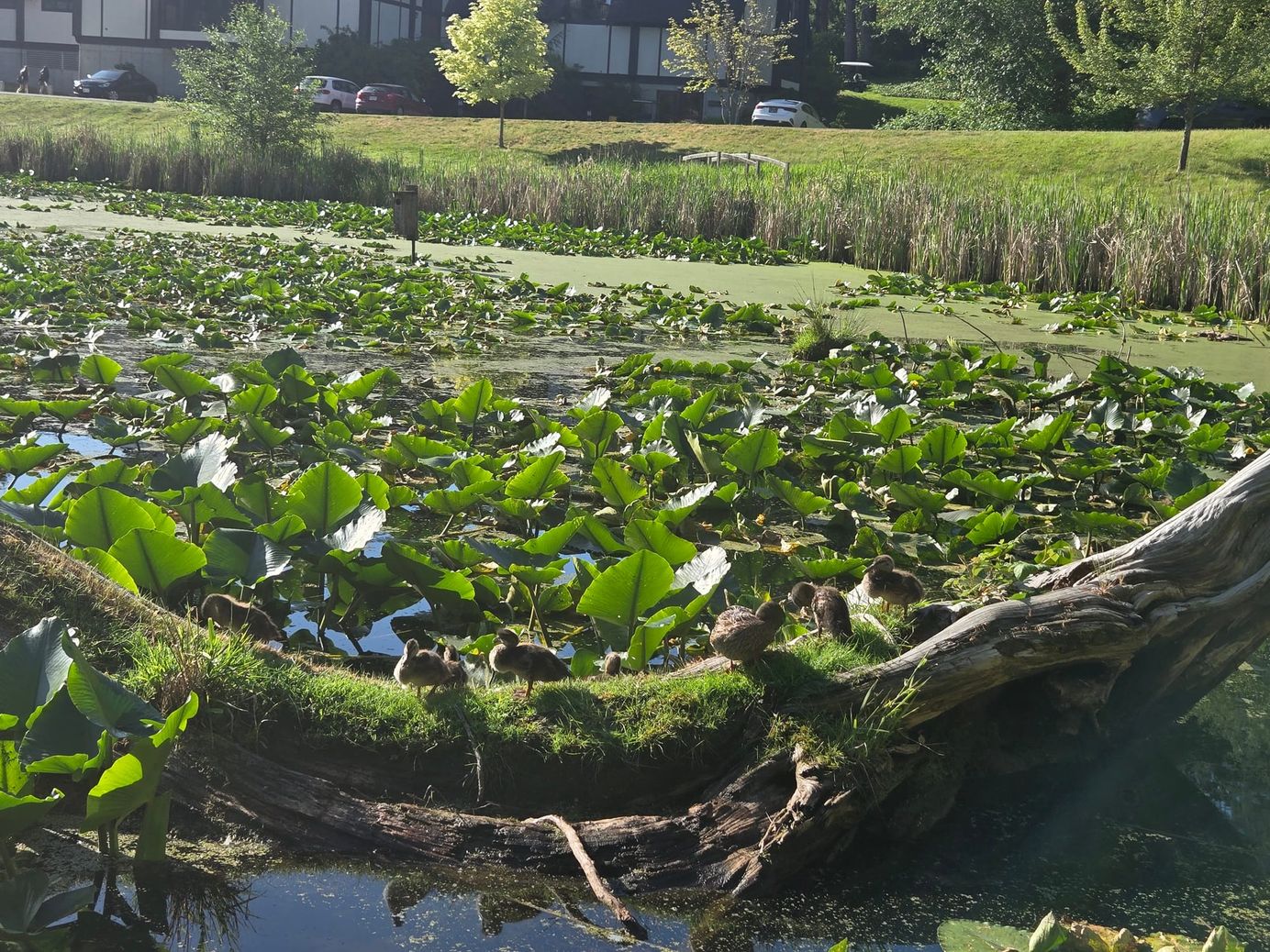
A catchment pond, like Lake Omar, supports complex aquatic life and provides significant environmental benefits, acting as a vital artificial ecosystem.
June 10, 2026
Patricia Hanbidge, Lead Horticulturist, Orchid Horticulture
Key points from this story:
- Catchment ponds enhance local ecosystems.
- Lake Omar supports diverse aquatic life.
- Wolfia spp. is a tiny, unique plant.
- Duckweed offers high protein content.
- Environmental impact of duckweed is minimal.
- Alternative protein source for global needs.
Last week, the focus was all about a catchment or retention pond (Lake Omar) that I overlook while I am working on Vancouver Island. This body of water is teeming with life and is an endless source of entertainment. What is even more amazing is what a catchment pond can do for the local environment. This pond has a function to hold rainfall run-off on a temporary basis. But actually, the work of these water bodies is so much more than that. A permanent retention pond, acts as a vital artificial ecosystem that provides significant environmental benefits. Water that is sustained throughout the year supports complex aquatic life and this biodiversity creates a thriving habitat oasis.
Last summer, we had an uncommon influx of aphids which particularly impacted the native water lilies that are growing in Lake Omar. It was odd as I was reading about many other aphid infestations that were happening in many places. Most of these infestations were attributed to climate change with a slight increase in the overall mean temperature. Soon after the waterlilies had a dormant phase in early summer, I noticed a greening up on the pond. It was not algae but in fact duckweed that was rapidly turning the surface water green. There was the regular duckweed I have seen countless times, but it was the first time I had ever seen mealy duckweed.
Wolfia spp. is an Indigenous species of duckweed that first showed itself last summer on Lake Omar. This genus (Wolfia) contains a number of rootless aquatic plants that are considered the smallest flowering plants on Earth. They have a very cosmopolitan distribution so can be found in many nutrient-rich and still bodies of water. Each individual plant is a tiny, bright-green oval about the size of a grain of salt or cornmeal, giving it a unique texture. Students who were helping with the Coho salmon and Rainbow Trout release at the beginning of May had the opportunity to view this tiny plant through a compound microscope.
The plant body of watermeal are entirely free-floating, branchless and lack both roots and true leaves. The consist of a simple, oval vegetative body called a thallus. They are technically a flowering plant, but the flower itself is quite unique. It has only one stamen and one pistil and forms in a tiny depression on the top of the plant's frond. So the smallest flowering plants in the world are definitely not too showy!
The ideal place for Wolfia to grow is warm water bathed in bright light. They reproduce exponentially via vegetative budding, and can double their population in just one or two days. Thriving in nutrient-rich freshwater environments, they form dense, green mats across the surface of lakes and ponds. There are almost a dozen species within the genus and I believe our major species in Lake Omar is Wolfia columbiana. This Indigenous species is an entirely spherical transparent- green plant.
This plant is a super-food and a viable alternative to animal protein and soy. It contains up to 40% protein by dry weight and is packed with essential amino acids, dietary fibre, vitamins and minerals. Cultivating this plan is incredibly environmentally friendly as it requires a fraction of the land and water that traditional crops demand.
Our world is experiencing global population growth and in emerging countries the demand for meat has triggered a "protein crisis" as the demand for protein has exceeded the supply. By 2030, the imbalance between demand and supply is projected to become critical by 2030. Our duckweed (and other Wolfia species) right here on Lake Omar could stand ready to solve this global crisis. This fast-growing crop is enjoying rising expectations as an alternative protein source to meat and soybeans.
In Hokkaido, Japan, the Floatmeal Company is a startup business in Japan's largest food production region who are hoping to promote duckweed as a solution to the global protein crisis. The environmental impact of Wolfia is remarkably low using only 1/230 the water and 1/63 the land required for soybean production. The protein content is also high - 36 to 40% compared with about 34% for soybeans and 28% for broccoli. Also rich in vitamins and minerals, wolfia could be the next focus of attention as a potential superfood to replace conventional protein sources.
Hanbidge is the Lead Horticulturist with Orchid Horticulture. Find us at www.orchidhort.com; by email at growyourfuture@gmail.com on facebook @orchidhort and on instagram at #orchidhort.
Tune into GROW Live on our Facebook page https://www.facebook.com/orchidhort or check out the Youtube channel GROW... https://www.youtube.com/channel/UCzkiUpkvyv2e2HCQlFl0JyQ?
Last Mountain Times Newsletter
Join the newsletter to receive the latest updates in your inbox.