
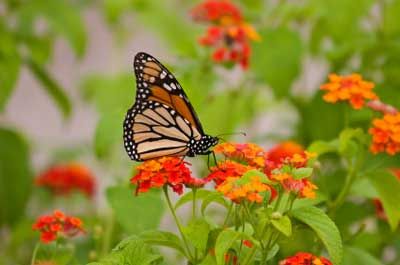
The monarch butterfly
Monarch butterflies (*Danaus plexippus*) migrate up to 3000 miles every autumn, entering a non-reproductive state called "diapause" for up to eight months before heading south to overwinter in Mexico or California.
August 03, 2026
Patricia Hanbidge, Lead Horticulturist, Orchid Horticulture
Key points from this story:
- Monarchs migrate up to 3000 miles
- Enter diapause for up to eight months
- Live up to nine months
- Navigate using solar compass
- Multiple generations complete migration
- Plant native milkweed to attract monarchs
When we think of migration, it is often the songbirds that we think about. However, monarch butterflies (*Danaus plexippus*) migrate up to 3000 miles (4800 km) every autumn. It is difficult to fathom that our beautiful monarchs can complete this almost unbelievable migration. Monarchs that are born in late summer or early fall enter the "diapause" phase which is a non-reproductive state. They stay in this state for up to eight months and fly thousands of miles south to overwinter in the central Mexico oyamel fir forests or to California.
This is especially unique as most adult butterflies only live two to four weeks. Some smaller butterflies may only live a few days while the Monarchs survive for up to nine months. Adult butterflies feed primarily on liquids using a straw-like tongue called a proboscis in order to fuel their flight, mate and lay eggs. Nectar from flowers are their main source of sugar and energy, but butterflies also feed on tree sap, rotting fruit and dung for minerals and amino acids. Males will also gather on mud puddles (called puddling) to absorb essential salts and sodium.
Butterflies undergo complete metamorphosis progressing through four distinct lifecycle stages. Females will lay tiny eggs on specific host plants that will feed the newly hatched young. The larval stage is the primary feeding and growth stage. So yes, before the butterfly comes the worm (technically a caterpillar) which shed their skins multiple times as they go through rapid growth. The pupa or chrysalis is the transformation stage where the caterpillar reorganizes its tissues into a fully formed butterfly inside a protective casing. The adult or imago stage is focused on reproduction, pollination and migrations before restarting the cycle.
Monarch butterflies hold the record for the longest migration by a single insect and navigate using a combination of a time-compensated solar compass. This type of navigation uses the sun's position alongside their internal circadian clock and magnetic receptors in their antennae. How amazing it is to see both sides of this lengthy migration!
This migration is not a simple one, but actually takes multiple generations to complete both directions of the migration. In the spring, these overwintered monarchs head north to mate, lay eggs on milkweed and die. It takes 3 to four successive generations to repopulate North America each summer. This multigenerational relay goes as such:
- Generation 1 (spring) overwintering monarchs leave Mexico in March, move into the southern US and lay eggs on Milkweed before dying. This generation hatches, matures and migrates in the Midwest and Northeast.
- Generation 2 and Generation 3 (summer) These are born in late spring and mid-summer and only live for 2 - 6 weeks with the sole focus of breeding and moving further north - reaching the northern US and southern Canada.
- Generation 4 (fall) born in late summer/fall these do not reproduce immediately, but instead live 6 to 9 months and migrate up to 3000 miles south to Mexico for the winter and head north again in spring to start the cycle again.
To attract monarchs, plant native milkweed species such as common, showy and dwarf along with native flowering plants that provide nectar for adult butterflies. Planting tropical milkweed and other non-native varieties can disrupt the migration patterns and spread harmful parasites. In Saskatchewan, the monarch butterflies arrive from late May through mid-June to breed, relying on native milkweed before heading south by late summer.
In order to aid our monarch butterflies, we need to take action! Please avoid mowing natural ditches and prairie patches where milkweed grows between June 1 and September 15. There is heavy habitat loss of the native milkweed in Canada and this coupled with the winter forest degradation in the south has helped to decrease the population of the monarchs. As always, skip the pesticides and add native asters and goldenrods to help feed the adult monarch butterflies for their long journey south.
Last Mountain Times Newsletter
Join the newsletter to receive the latest updates in your inbox.